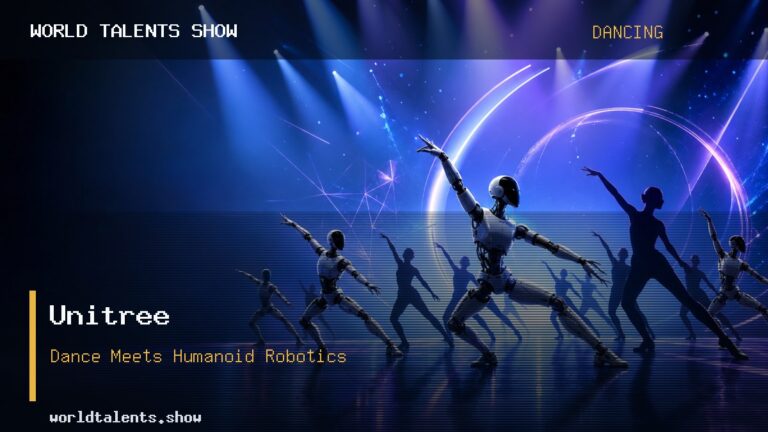
Dance is often defined by human connection: performers sharing timing, energy and space until individual movements become a single picture. Unitree’s America’s Got Talent audition asks audiences to look at that idea differently. The act pairs Chinese dancer Yufei Wu, known as Flying Bug, with a group of humanoid robots from Unitree Robotics in a performance where choreography and technology meet on a major talent-show stage.
Presented during the 2026 season of America’s Got Talent, the audition is memorable not simply because robots appear in it, but because the production treats them as part of a dance ensemble. The result is an unusual entry for a dancing category: a performance built around rhythm, coordination and the contrast between a human lead and machine partners.
Watch the Performance
The official video introduces Unitree’s audition with Flying Bug alongside the company’s humanoid robots. The routine is set to Lady Gaga’s “Abracadabra” and uses the music’s driving beat as a framework for synchronized movement. Rather than attempting to turn the robots into human substitutes, the presentation makes their mechanical form part of the visual language.
Viewers can approach the act from two directions at once. It is a dance performance, with timing and formation at its center; it is also a live demonstration of what controlled humanoid movement can look like in an entertainment setting. That combination gives the audition a distinct atmosphere, especially for audiences accustomed to seeing either solo dancers or traditional groups on the Got Talent stage.
The People and Technology Behind the Act
Flying Bug is the stage name of Yufei Wu, a Chinese performer associated with the presentation. The robots are Unitree G1 humanoid models from Unitree Robotics, a company known for developing legged robots. Unitree’s G1 platform is designed with multiple joint motors, onboard sensing and a humanoid structure intended to support agile motion and research applications.
That technical context matters, but it does not fully explain why the act works as television. A robot capable of moving is not automatically a dancer. For movement to read as choreography, it needs a clear relationship to musical rhythm, spacing and the performers around it. This audition places those elements front and center, using the presence of a human dancer to make the robotic movement easier to follow as a performance rather than as a product demonstration alone.
The collaboration also avoids a simple human-versus-machine storyline. Instead, Flying Bug serves as a point of reference within the ensemble. His role helps audiences notice the differences in texture between human movement and programmed motion, while the group format creates a sense of scale that a single robot could not provide.
What Makes This Dance Performance Worth Watching
The strongest idea in the audition is synchronization. Group dancing depends on performers arriving at the right place at the right time, and the Unitree presentation draws attention to that discipline through repetition, unison and carefully arranged stage patterns. The robots’ compact humanoid forms make their movements instantly readable against the larger AGT stage, while their shared design gives the ensemble a clean visual identity.
There is also an effective tension between precision and unpredictability. Human performers naturally adapt to a stage in the moment; robots invite viewers to wonder how movement, balance and coordination are being managed. That curiosity becomes part of the viewing experience. It encourages audiences to look closely not only at isolated moves, but at the act’s overall control of space and rhythm.
Importantly, the routine does not need viewers to understand robotics in order to enjoy it. Fans of dance can focus on the beat, the formations and the relationship between the central performer and the group. Technology-minded viewers can appreciate the difficulty of presenting coordinated humanoid machines in a live-show environment. The crossover appeal is one reason the audition reached beyond the usual boundaries of a dance act.
A Talent-Show Moment With a Wider Conversation
Humanoid robots have appeared in public demonstrations before, but a talent competition changes the context. The format asks a direct question: can technical achievement also function as entertainment? Unitree’s audition answers by framing robotics through the familiar tools of a stage routine—music, reveal, ensemble work and performance pacing.
The act also invites reasonable debate about authorship. Dance is not only the person or object visible on stage. It can include choreographers, programmers, engineers, technicians and performers working toward a shared result. In this case, the creative interest lies partly in that collaboration. The audience sees a polished routine, while the broader project brings together movement design and robotics expertise.
At the audition, Unitree received four yes votes from the judges, sending the act forward in the competition. Whatever a viewer’s perspective on robots in entertainment, that result confirmed the act’s ability to make an immediate impression in a format built on short, high-pressure performances.
Why Unitree Stands Out in Dancing
Unitree stands out because it does not present dance technology as background decoration. The robots are integral to the act’s structure, and Flying Bug’s presence keeps the performance anchored in the expressive, physical language of dance. The concept is futuristic, but its foundations are familiar: musicality, coordination, contrast and a memorable stage image.
For World Talents Show, this is a compelling example of how a dancing performance can expand without abandoning its essentials. It may not fit every traditional definition of dance, yet it relies on the same core qualities that make ensemble work effective: timing, trust in the routine and a strong sense of collective motion.
World Talents Show View
Unitree and Flying Bug’s AGT appearance is worth watching as a carefully staged meeting point between dance and engineering. It does not require audiences to choose between admiring human artistry and appreciating technology. Its interest comes from watching both elements share one performance space, each making the other more noticeable.
As talent-show acts continue to evolve, this audition offers a useful reminder that innovation is most engaging when it has a clear performance purpose. Here, the technology is not the entire story. The story is how rhythm, movement and collaboration can make an unfamiliar kind of ensemble feel at home on a dance stage.
Video Source & Credit
Original video: Early Release: Unitree’s Robots Leave Simon Cowell SPEECHLESS! | Auditions | AGT 2026.
Official publisher/channel: America’s Got Talent, the verified official YouTube channel for the NBC talent competition.
Original YouTube URL: https://www.youtube.com/watch?v=y7ojRmPxqNg
This article is an independent editorial draft for World Talents Show. The embedded performance video and related show footage remain credited to their respective original owners and publishers.