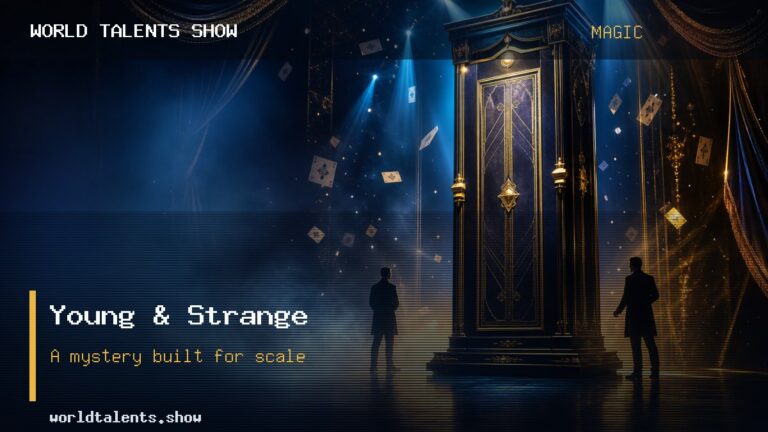
Grand illusion is often associated with spectacle: oversized props, bold staging and an ending designed to make an entire theatre question what it has just seen. In their America’s Got Talent 2026 Quarterfinals appearance, Young & Strange brought that large-scale tradition to the competition stage while retaining the playful double-act character that has shaped their work for years.
The British duo, made up of Richard Young and Sam Strange, are established illusionists rather than newcomers learning under the pressure of television. Yet a live talent-show quarterfinal creates its own challenge. The performers must communicate a clear premise quickly, build anticipation for a broad audience and deliver an effect that works both in the room and for viewers watching at home. Their performance is therefore an interesting example of how theatrical magic is adapted for a fast-moving televised competition.
Watch the Performance
The official AGT video presents Young & Strange attempting what is described as a world-first grand illusion. Its central premise is deliberately ambitious: the act is framed around apparently difficult conditions, with the performers drawing attention to the lack of an obvious hiding place or exit.
That setup matters in illusion. Instead of asking an audience merely to accept a mysterious result, it invites viewers to look for possible answers before the effect reaches its conclusion. Whether someone is a regular magic fan or simply watching for the surprise, the pleasure comes from following the duo’s stated challenge and seeing how confidently they pursue it.
From Childhood Friends to a Professional Magic Partnership
Young & Strange are childhood friends Richard Young and Sam Strange. Their official biography describes them as a comedy illusion duo, and their career has included theatre, touring and television work. They have appeared in productions including Champions of Magic, the international touring show that brings together performers from several branches of the art.
This background helps explain the combination on display in their AGT work. Their identity is not built solely around close-up technique or a single visual stunt. They work as a partnership, using conversation, timing and the occasional sense of things going slightly off course to create a more relaxed route into an otherwise technically demanding style of magic.
The duo have also appeared on programmes including Penn & Teller: Fool Us and ITV’s The Next Great Magician. That experience does not reduce the difficulty of competing on AGT, but it does show a long-term commitment to developing material for both live and broadcast audiences. They arrived on the American stage with an established collaborative language and an understanding of how to make an illusion feel like an event.
Why This Quarterfinal Performance Is Worth Watching
The immediate appeal of this performance is scale. Television talent competitions frequently feature magicians, but a grand illusion has different demands from card magic or a brief prediction. It needs to establish the physical situation clearly enough for the audience to appreciate what appears impossible. Young & Strange make that explanatory phase part of the entertainment rather than treating it as a pause before the trick.
There is also a useful contrast between the size of the challenge and the duo’s comic manner. Grand illusions can sometimes be presented with total solemnity, but Young & Strange approach their material as two performers sharing a high-pressure undertaking. That approach gives the routine an accessible personality. The viewer is not required to know the vocabulary of stage magic; it is enough to understand that the performers have set themselves an unusually difficult-looking task.
For audiences interested in performance craft, the video is also a reminder that magic depends on more than secrecy. The construction of suspense, the clarity of the premise, the relationship between the two performers and the pacing of the reveal all shape the impact. A successful illusion is not only about concealing its method. It is about directing attention toward a question the audience genuinely wants answered.
A Large-Scale Act with a Human Dynamic
Young & Strange stand out because their act has two complementary dimensions. On one level, they aim for the visual reach associated with major theatre and Las Vegas-style illusion shows. On another, they perform with the familiarity of longtime friends who can turn a moment of tension into a comic exchange. The combination gives their work a distinctive tone: polished without becoming distant, and playful without losing the sense of risk that a major illusion requires.
Their quarterfinal routine also shows why partnership is valuable in magic. Two performers can divide attention, establish competing points of view and create a rhythm that a solo act cannot reproduce in the same way. For Young & Strange, the duo format is not simply a practical arrangement. It is part of the storytelling.
What Happened After the Quarterfinal
Young & Strange’s AGT 2026 journey continued after this performance. Following the quarterfinal vote, they were announced among the acts advancing to the semifinals. That result placed them in the next stage of the competition and gave them another opportunity to present their style of theatrical magic to the show’s national audience.
Advancement is especially meaningful for a large-scale illusion act because each new round raises expectations. Viewers who have already seen one ambitious premise naturally want to know how the performers will build on it. For the duo, the semifinal place recognized not only a single routine but also the potential of their broader stage identity.
World Talents Show View
This is a worthwhile watch for viewers who enjoy magic that thinks beyond a tabletop or a deck of cards. Young & Strange bring a professional illusion-show sensibility to AGT while keeping the presentation inviting and character-led. The official video’s “world-first” framing should be viewed as part of the performance’s stated premise, but the broader appeal is easy to understand: the duo make room for comedy, anticipation and visual scale in the same short television slot.
Rather than explaining away the mystery, the performance lets the challenge remain at the centre. That is a smart choice. It allows the audience to experience grand illusion in the way it is intended to work: as a shared moment of uncertainty, followed by a result that encourages a second look.
Video Source & Credit
Original video: Young & Strange Attempt A WORLD-FIRST Grand Illusion! | Quarterfinals | AGT 2026.
Official publisher/channel: America’s Got Talent on YouTube.
Original YouTube URL: https://www.youtube.com/watch?v=G14nD-rFsug
This article is an independent editorial draft about the performance. Video footage, programme branding and related rights remain with their respective owners and the original publisher.